
AI Integration Consulting for Business Growth in 2026
 Vladimiros MykogianSeptember 26, 2026
AI integration consulting helps companies identify high‑impact use cases for artificial intelligence, design the right technical approach, then embed AI safely into everyday workflows. When done well, it stops being a novelty project and becomes a steady engine for revenue, efficiency, and better decisions.
This guide walks through how AI integration consulting actually works, which decisions matter, and how to choose the right partner if you want AI to drive real business growth, not just slide decks.
What is AI integration consulting and why does it matter for growth?
AI integration consulting is a structured service that evaluates where AI can create value in your business, then designs and ships the systems, data flows, and user experiences that make those AI capabilities usable in real work. It connects strategy with implementation so you are not stuck at “ideas” or, worse, at half‑baked pilots.
For growth‑oriented teams, the value is simple: you reduce manual effort, respond faster to customers, and make decisions using richer data instead of intuition alone. That combination tends to show up as lower costs and higher revenue per employee.
An effective consulting engagement focuses less on “Which model is hottest this quarter” and more on questions like:
- Where are people repeating the same task 20+ times per week?
- Which decisions are high value but currently depend on scattered spreadsheets or chat threads?
- Where do customers feel friction or wait for answers?
If an AI integration never touches those pressure points, it will not move your key metrics, no matter how impressive the tech looks in a demo.
How does an AI integration consulting project typically run end to end?
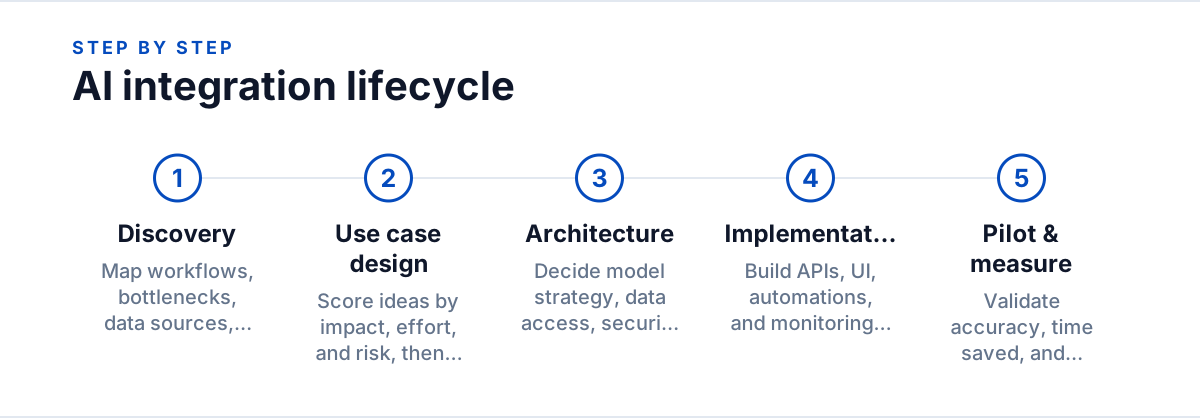
Every consulting firm has its own jargon, but successful AI integration projects usually follow the same backbone: discover, design, build, and scale. Knowing the stages helps you ask sharper questions and spot weak proposals early.
1. Discovery: understand workflows and value levers
Discovery maps how work actually happens today. Consultants interview teams, review tools, and walk through live processes. The aim is to surface:
- Bottlenecks and repeatable tasks
- Data sources and data quality
- Edge cases and risk points (compliance, approvals, financial impact)
If this stage feels rushed, expect surprises later. Strong teams share early views on feasibility, rather than nodding at every idea.
2. Use case design: choose what to build first
Next comes prioritization. A good AI integration consulting partner scores ideas on business impact, implementation effort, and risk. You want a shortlist of 1 to 3 use cases that can ship quickly and prove value.
Selected use cases are refined into concrete user stories, such as “Support agents see suggested replies and customer context in one panel” instead of “Use AI for support.” This level of clarity prevents scope creep and misaligned expectations.
3. Architecture and model strategy
Architecture work answers: where does the AI run, what data does it see, and how does it connect to your existing systems. The team will decide between:
- Calling external foundation models via API
- Fine‑tuning or specializing models on your data
- Using techniques like retrieval augmented generation (RAG) to ground responses
Security, observability, and fallbacks belong in the design, not bolted on later.
4. Implementation and integration
Developers build the APIs, UI components, automations, and monitoring needed to make AI part of daily work. For complex products, this often includes CI/CD pipelines that safely deploy updates without interrupting users, something we discuss in detail in our guide on CI/CD pipeline best practices.
At this stage, tight loops with real users are essential. Short feedback cycles beat big‑bang launches.
5. Pilot, measure, and iterate
AI systems rarely land perfectly on day one. Pilots validate:
- Accuracy and reliability in real scenarios
- Time saved per task or per team
- Impact on key metrics like resolution time or conversion rate
Based on real data, you refine prompts, thresholds, and UX. Treat the pilot as a working lab, not a checkbox.
6. Scale and governance
Once a use case proves its value, you scale it to more users, more data, or more markets. Mature consulting partners also help you set governance: access controls, audit logs, regular evaluations, and clear ownership. This is where AI moves from “project” to “infrastructure”.
Where can AI integration consulting create the highest ROI first?
AI belongs where it consistently saves hours or increases revenue, not where it simply looks impressive in a demo. The highest ROI use cases usually live close to your customers or your core operations.
Common early wins include:
- Customer support augmentation: Suggested replies, auto‑draft summaries, and knowledge retrieval so agents resolve tickets faster.
- Sales and marketing workflows: Personalized outreach drafts, lead scoring using behavioral data, content generation aligned with your playbooks.
- Internal knowledge search: Chat interfaces on top of documentation, tickets, and wikis using techniques such as retrieval augmented generation.
- Operations and back‑office automation: Document classification, data entry from PDFs, routing tasks based on content.
In our work at LetrionAI, the most successful first projects usually sit at the intersection of three traits: clear existing process, enough structured data, and a measurable outcome like “tickets per agent” or “time from lead to proposal.” That clarity lets you show impact in weeks, not quarters.
How to decide which AI use cases to prioritize in your business
Many teams start with a wishlist of ten ideas and then stall because everything feels important. A simple scorecard approach helps you rank and commit.
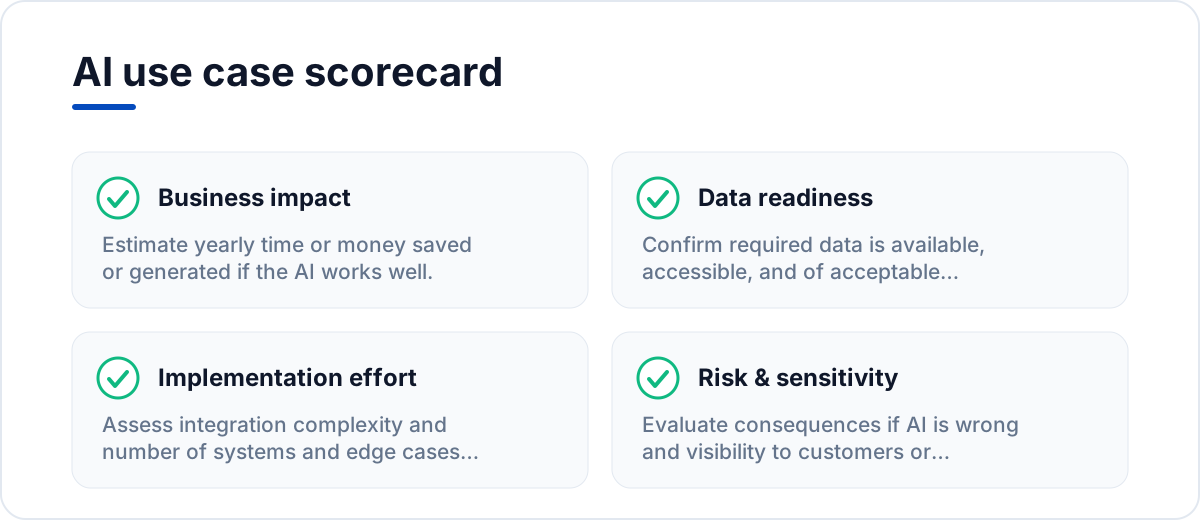
Use this 4‑factor checklist for each candidate use case:
- Business impact: If this works well, how much money or time could it save or generate in a year?
- Data readiness: Do you have the data this AI would need, in accessible systems, with acceptable quality?
- Implementation effort: How many systems must integrate, and how complex are the edge cases?
- Risk and sensitivity: What happens if the AI is wrong, and how visible is that mistake to customers or regulators?
Simple 5‑step prioritization process
- List all ideas, one per line, without judging.
- Score each idea from 1 to 5 on the four factors above.
- Add the scores to get a total per idea.
- Keep the top three, discard or park the rest.
- For each of the top three, define a 6 to 8 week pilot scope.
This lightweight process is often more effective than complex frameworks and it prepares you for a focused conversation with any AI integration consulting partner.
What technical foundations are required for successful AI integration?
You do not need a perfect data warehouse or a complete microservices refactor before using AI. You do need a sane technical baseline so the AI system can access data, run reliably, and avoid blocking the rest of your stack.
Key foundations include:
- Clean integration points: APIs or event streams that expose the data AI needs, without violating security.
- Cloud infrastructure that can scale: Even modest AI use can spike compute and storage. Running on providers like AWS, GCP, or Azure with containerization (for example Docker and Kubernetes) makes it easier to scale up and down.
- CI/CD and observability: Automated tests, deployments, and monitoring for both application and model behavior.
- Data practices: Ownership, access control, backup policies, and basic documentation.
If your stack is currently a monolith with manual deployments, a good consulting partner will balance pragmatism and improvement. Sometimes the right call is to wrap existing systems with new APIs instead of rewriting everything.
How AI integration consulting aligns with product, data, and UX teams
AI touches many parts of your organization. If consulting work happens in a silo, you will either ship something nobody adopts or a system that quietly breaks other processes.
A strong AI integration engagement deliberately involves:
- Product management, to define outcomes, success metrics, and trade‑offs.
- Engineering and DevOps, to integrate with services, maintain performance, and keep deployments safe.
- Data teams, to provide and govern data sources and metrics.
- UX and design, to make AI support visible but not distracting inside existing interfaces.
Our own approach at LetrionAI is to treat each AI project as a product, not a feature. That means the same discipline we use for web, mobile, and SaaS work applies: user research, hypothesis‑driven roadmaps, and iterative UX. If you want a deeper dive into this mindset, our article on UX and UI design covers how strong interfaces and research drive adoption.
AI integration consulting vs generic AI automation services
You will see many offers that promise AI automation or AI agents with minimal setup. These can be useful for simple tasks, but they are not the same as structured AI integration work.
Here is a comparison to clarify when you need each:
| Aspect | AI integration consulting | Generic AI automation services |
|---|---|---|
| Primary goal | Long‑term, integrated capabilities tied to business metrics | Quick wins on isolated tasks |
| Scope | End‑to‑end: strategy, architecture, build, and governance | Narrow: connect tools, set up prebuilt workflows |
| Customization | High, often involving custom models or RAG on your data | Template based, limited depth |
| Technical depth | Deep involvement in backend, data, and security | Mostly configuration of existing tools |
| Ownership | You own architecture and code where custom work is done | Vendor owns the platform and workflows |
| Best for | Core workflows and competitive advantage | Peripheral or low‑risk tasks |
If a workflow touches revenue, compliance, or your main product experience, you usually want real AI integration consulting. For small internal chores, generic automation may be enough.
How to choose the right AI integration consulting partner
Choosing a partner is a high‑impact decision. You are giving them influence over your architecture, data flows, and how your team works. Look for signals that they can both think at the business layer and execute at the engineering layer.
Key criteria to evaluate:
- Hands‑on shipping record: Ask for examples of live products or automations, not just prototypes.
- Stack familiarity: Can they work with your languages, frameworks, and cloud provider, or will everything be a rewrite?
- Security and reliability mindset: How do they handle access control, logging, and incident response?
- Measurement culture: Can they describe how they tracked ROI on past projects?
- Education and communication: Can they explain trade‑offs clearly to both technical and non‑technical stakeholders?
At LetrionAI, we have delivered more than 150 projects across web, mobile, backend, and workflow automation, and we keep both clients and our free education students close to the fundamentals of AI, software engineering, and business intelligence. That dual track means our consulting work tends to be both technically grounded and easy to understand for leadership teams.
What does working with an AI integration consultant feel like day to day?
Beyond contracts and architecture diagrams, the daily collaboration experience will define whether a project succeeds. You should expect:
- Short, focused status updates with clear next actions.
- Shared documentation of workflows, assumptions, and prompts.
- Open channels for your team to give feedback during pilots.
- Transparent discussions when trade‑offs appear, instead of surprises.
A healthy engagement feels like working with a product squad that happens to be expert in AI, not a distant advisory group that drops a report and vanishes.
If you want AI to drive real business outcomes, start by mapping your key workflows, shortlist the use cases that score highest on impact and feasibility, then talk to a consulting partner who can speak fluently about both your metrics and your stack. From there, a small, well‑scoped pilot is often only a few weeks away.
Conclusion
AI integration consulting is not about chasing the latest model trend. It is about weaving AI into the fabric of your workflows so teams can move faster, make better decisions, and serve customers with less friction. If you are ready to explore where AI fits in your product or operations, outline three candidate use cases, define the metric that matters for each, and reach out to an AI integration specialist for a focused, outcome‑driven conversation.