
Comprehensive Guide to AI Integration Services
 Vladimiros MykogianOctober 13, 2026
AI integration services connect artificial intelligence systems with your existing software, data, and workflows so they deliver measurable business outcomes instead of isolated demos. Done well, they translate models and tools into faster operations, better decisions, and new product capabilities.
In this guide, you will learn what AI integration services include, how they work in real projects, which options fit different business sizes, and how to choose the right partner and scope for your next initiative.
What are AI integration services and why do they matter now?
AI integration services are the planning, engineering, and change management work required to plug AI models into your existing systems so they create real, repeatable business value. They bridge the gap between "AI in theory" and working features that your team actually uses.
For most companies, the problem is not access to AI models anymore. You can get powerful language, vision, or recommendation models in minutes. The real challenge is turning those capabilities into reliable workflows that respect your security, data quality, and compliance requirements.
The right AI integration approach matters because it determines:
- How safely your proprietary data is used and stored
- Whether AI outputs are accurate enough for your use case
- How quickly your team can adopt and trust new workflows
- If the system will scale as usage and data grow
In short, AI integration is now a core software and product decision, not a "nice to have" experiment on the side.
What problems can AI integration solve in real businesses?
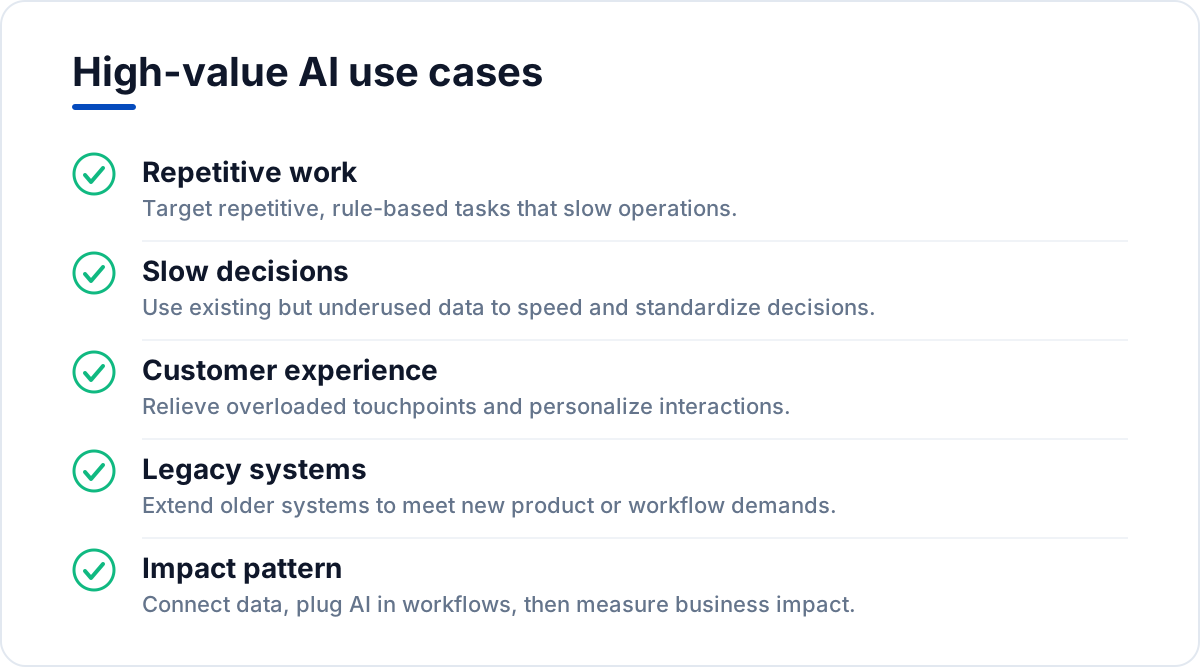
AI integration services are most valuable when they target specific business problems, not abstract innovation goals. Instead of asking "Where can we use AI?", start from "Where are we losing time, money, or opportunity?" and work backward.
Typical problems where AI integration pays off:
- Repetitive, rule-based work that slows down operations
- Slow or inconsistent decisions where data exists but is not used
- Customer interactions that feel generic or overloaded
- Legacy systems that cannot keep up with new product demands
Concrete examples include:
- Automatically triaging support tickets, routing high-priority cases to humans
- Generating first-draft marketing content that respects your brand tone
- Extracting structured data from invoices, contracts, or PDFs
- Building recommendation or ranking engines inside web or mobile apps
- Powering internal search over documents using techniques like retrieval augmented generation, which you can learn more about in our guide on how RAG makes AI more accurate
The pattern is always the same: connect data, choose or build the right AI component, wrap it in a product or workflow, then measure the impact.
How do AI integration services work from discovery to launch?
A strong AI integration project follows a clear, opinionated lifecycle. Skipping steps creates fragile proofs of concept that never reach production. While details vary, a practical flow usually looks like this.
- Discovery and opportunity mapping: You map current workflows, systems, and pain points. The goal is to pick 1 or 2 high-impact, low-dependency use cases, not a wish-list of ten.
- Feasibility and data assessment: You check data availability, quality, and access constraints. This includes security, PII handling, and compliance rules.
- Solution design: You define the target workflow, AI components, integration points, latency and accuracy requirements, and success metrics.
- Implementation and integration: Engineers connect APIs, build middleware, design prompts or custom models, and wire everything into your apps or tools.
- Evaluation and iteration: You run pilots, compare AI-assisted outputs against baselines, and tune prompts, thresholds, or model choices.
- Production rollout and monitoring: You harden infrastructure, add observability, monitor cost and quality, and plan ongoing improvements.
Throughout this cycle, the most successful teams treat AI integration as software engineering plus product thinking, not as a separate lab experiment. LetrionAI, for instance, combines its experience across 150+ shipped projects in web, mobile, backend, and automation with custom LLM integrations so that architecture, data pipelines, and user experience evolve together instead of in isolation.
What types of AI integration services exist and which do you need?
Not every company needs a custom model training pipeline. The right approach depends on your scale, data sensitivity, and speed requirements. In practice, AI integration services usually fall into a few patterns.
1. API-based AI enrichment
Here, you call external AI APIs from your applications. Examples include:
- Generating text or summaries from internal data
- Classifying content or routing tickets
- Translating or rewriting communication
This is ideal when:
- You need to move fast and validate value
- Your data can safely leave your environment under provider terms
- Latency from external calls is acceptable
2. Custom workflow automation with AI steps
AI acts as one step inside a broader automation, not the whole system. For example, a CRM workflow that enriches leads with AI-written notes, or an ETL pipeline that tags rows using a model.
This works well when your main pain is operational, and the AI piece is mainly there to reduce human friction. Our article on how businesses use AI automation gives more workflow-level examples that often overlap with integration projects.
3. Embedded AI features inside products
Product teams integrate AI directly into the core experience of web, mobile, or SaaS apps. Think AI search, recommendation, personalization, or content generation inside the interface.
Choose this path when AI is strategically central to your product, not just an internal helper. It demands tighter performance, design, and scalability work.
4. Hybrid or on-premise AI integrations
For highly regulated environments, you might deploy models in your own cloud accounts or private infrastructure. Integration here includes both infrastructure and application layers, plus stronger guardrails.
The decision rule: start with the simplest pattern that satisfies your security and performance constraints. Move to more complex setups only when the business case demands it.
How should you architect AI integration into existing systems?
Architecting AI integrations properly is the difference between a quick win and a long-term headache. You want components that can evolve as models, costs, and usage change.
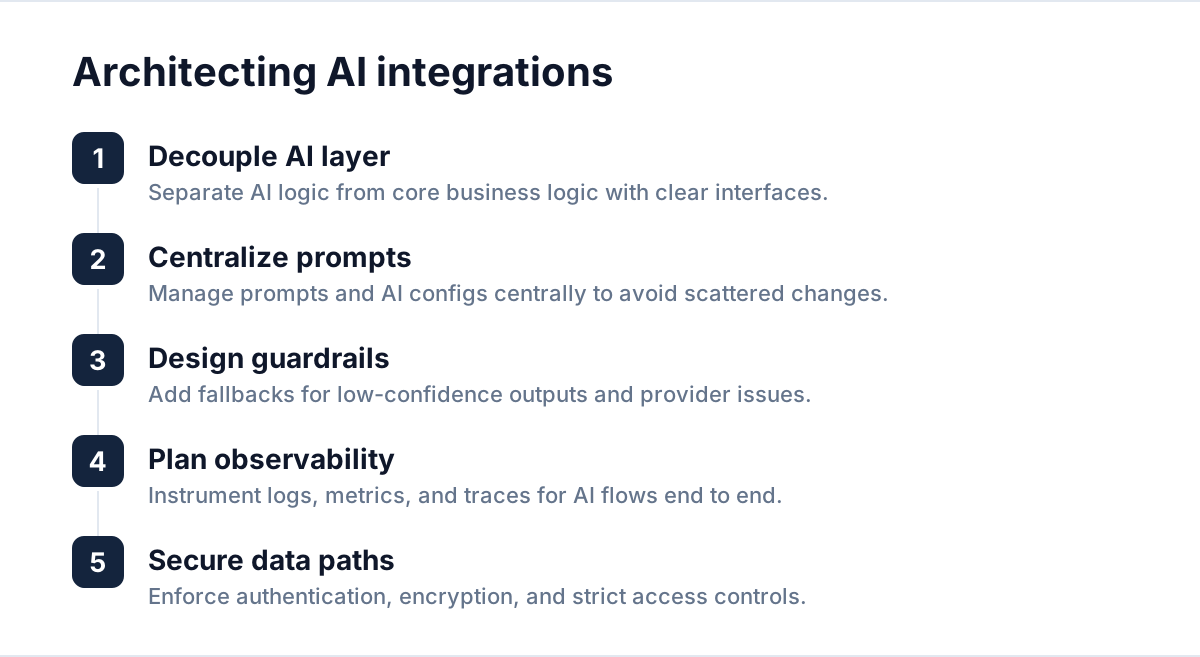
Key practices for architecture:
- Decouple AI logic from core business logic using clear interfaces or services
- Centralize prompt and configuration management so changes do not require code rewrites
- Design fallbacks and guardrails for low-confidence outputs or provider outages
- Plan for observability: logs, metrics, traces, and input-output sampling
- Secure data paths with proper authentication, encryption, and access controls
Layering AI into your stack
A clean architecture often has:
- A presentation layer (web, mobile, or internal tools)
- An application layer handling business rules
- An AI service layer abstracting calls to models, retrieval systems, or vector databases
- A data layer with transactional databases and warehouses
By isolating AI concerns in a dedicated layer, you can switch models, add caching, or change retrieval strategies without rewriting your entire app. Guides like our explanation of LangChain for AI-powered applications can help engineering teams standardize this layer.
Common mistakes in AI integration architecture
Teams often:
- Hard-code prompts and parameters inside UI code
- Tie AI calls to specific vendors with no abstraction
- Ignore rate limits and cost controls
- Skip monitoring, then struggle to debug quality issues
Avoiding these mistakes upfront saves months of rework later.
How do AI integration services compare to internal AI development?
Many leaders wonder whether to hire external AI integration services or build everything in-house. The right answer depends on your timeline, budget, and strategic focus.
Here is a comparison of typical trade-offs.
| Option | When it fits best | Strengths | Weaknesses |
|---|---|---|---|
| External AI integration services | You need results in months, not years, and lack senior AI engineering capacity | Faster path to production, cross-industry experience, pre-built patterns | Requires vendor coordination, risk of over-dependence if knowledge transfer is poor |
| Internal AI team | You view AI as a long-term core competency | Deep institutional knowledge, tight alignment with internal roadmaps | Slower to ramp, higher hiring and retention cost, hard to cover full stack (data, infra, product) |
| Hybrid model | You want speed now and capability later | External team accelerates delivery while training your staff | Needs clear ownership, risk of duplicated efforts if roles are unclear |
For most small and mid-sized teams, a hybrid approach is underrated. Use specialized AI integration services to design architecture, ship the first versions, and create playbooks. In parallel, upskill internal teams so they can own maintenance and future iterations.
How to choose the right AI integration services partner
Choosing a partner is a strategic decision. You are trusting them with your data, workflows, and future product capabilities. Focus on how they think about integration, not just which tools they list.
Evaluate partners along these questions:
- Do they ask about business outcomes before suggesting models or vendors?
- Can they discuss architecture, security, and DevOps, not just prompts?
- Have they shipped production systems, not only proofs of concept?
- Do they provide monitoring, documentation, and knowledge transfer?
- How do they plan change management and training for your team?
You can adapt criteria from evaluations you might already use when assessing SaaS development companies. The same logic applies: prioritize depth in engineering and clarity in communication over buzzwords.
When LetrionAI works on AI integrations, for example, we draw on our history of 150+ delivered projects, full-stack expertise from React and Node.js to Kubernetes and Terraform, and our education programs that keep our team sharp on AI engineering fundamentals. That combination makes us focus on architectures that scale, not one-off scripts.
What should your first AI integration project look like?
Your first AI integration project should be small enough to ship quickly but important enough that success is felt by real users or teams. Too often, companies pick low-risk, low-value use cases and end up "proving" that AI does not matter.
Aim for a 6 to 12 week window where you can:
- Define a clear owner and decision maker
- Pick a single business metric that AI should move
- Limit external dependencies (no five-team approvals)
- Agree on quality thresholds and failure modes
A practical first project could be AI-assisted support ticket triage, automated data extraction from one document type, or AI-enhanced internal search over a well-defined document set. The key is that everyone knows how success will be measured and what happens if quality is lower than expected.
Over time, you can stack multiple integrations, forming a broader AI automation strategy that connects customer-facing features with internal workflow gains.
How do you know if AI integration is working and worth the investment?
The value of AI integration services should be visible in your metrics, not only in demos. From the start, define how you will measure impact and what "good enough" looks like.
Useful indicators include:
- Hours saved per team per week on targeted workflows
- Changes in response times or cycle times
- Error rate or rework level before and after integration
- Revenue or conversion lifts for AI-powered product features
- User satisfaction or NPS for teams using AI tools
Qualitative feedback matters too. Are people voluntarily using the new AI features? Do they trust the outputs? Are they finding new, valuable use cases on their own?
Treat AI integration as an ongoing practice. Review performance regularly, retrain or retune models, and refine workflows. The organizations that win are not the ones with the flashiest models, but the ones that bake AI into the fabric of their products and operations.
Conclusion
AI integration services are the bridge between raw AI capabilities and durable business outcomes. When you treat them as serious engineering and product work, not experiments, you get systems that are secure, scalable, and genuinely useful to your teams and customers.
Start by identifying one meaningful workflow, pick the simplest integration pattern that fits your constraints, and work with people who can speak both business and engineering. If you want a second opinion on where to begin, schedule a short consultation and use it to pressure-test your first use case and architecture decisions.