
The Best AI Automation Tools in 2026 for Business Leaders
 Vladimiros MykogianAugust 5, 2026
AI automation tools in 2026 are no longer a competitive advantage reserved for large enterprises. They are a baseline requirement for any business that wants to move fast, reduce operational drag, and compete on outcomes rather than headcount. The real question is not whether to adopt them, but which ones are worth your engineering and organizational effort.
This guide cuts through the noise. It is written for startup founders, product managers, and business leaders who need a clear, actionable picture of where AI automation delivers real ROI and where it mostly generates impressive demos.
What "AI Automation" Actually Means in 2026
The term gets stretched in every direction, so let us define it precisely. AI automation combines machine learning models, often large language models (LLMs), with workflow orchestration to replace or accelerate tasks that previously required continuous human judgment.
That covers a wide spectrum:
- Document and data processing: extracting, classifying, and routing structured information from unstructured sources (invoices, contracts, support tickets).
- Code generation and review: AI-assisted development that speeds up sprint velocity.
- Customer-facing agents: chatbots and voice assistants that handle tier-1 support or lead qualification without human handoff.
- Internal workflow orchestration: connecting SaaS APIs, triggering actions based on events, and routing approvals without manual intervention.
Each category has different maturity levels, different integration costs, and different failure modes. Knowing which bucket your use case belongs to is the first decision you need to make.
The Four AI Automation Tools Categories Worth Your Attention
1. LLM-Powered Workflow Orchestration
This is where the most enterprise value is being unlocked in 2026. Frameworks built around LLMs allow you to chain AI reasoning steps together: retrieve context, call an API, make a decision, write output. Think of it as giving a junior analyst a set of tools and a clear brief, except it runs in milliseconds and never forgets the brief.
The key technical building blocks are retrieval-augmented generation (RAG), function calling, and agent loops. A well-architected RAG pipeline, for example, lets your AI answer questions grounded in your own internal documentation rather than hallucinating answers from general training data. For product and operations teams, this translates into internal knowledge bases, automated report generation, and intelligent escalation routing.
What to watch: agent reliability degrades sharply when tasks require more than four or five sequential decisions. Keep early automations tightly scoped.
2. No-Code and Low-Code Automation Platforms
Visual workflow builders have matured significantly and now include native AI steps. You can build automations that call an LLM to classify an inbound email, then branch the workflow based on the classification, all without writing a line of code.
These platforms are ideal for operations, marketing, and customer success teams who need to move quickly without waiting on an engineering sprint. The constraint is customization: once your logic becomes complex, or once you need to process high data volumes with reliability guarantees, you will hit the ceiling of what a drag-and-drop canvas can do. At that point, a custom-built solution becomes the more cost-effective long-term choice.
3. AI-Assisted Software Development
For technical founders and engineering leads, AI coding assistants integrated directly into the development environment have become a genuine productivity multiplier. The gains are clearest in boilerplate generation, test writing, and code review summaries. Teams that adopt these tools consistently report faster iteration cycles, though the biggest productivity lift comes from pairing the tools with strong engineering discipline, not replacing it.
At LetrionAI, we use AI-assisted development as a standard part of our build process for web and mobile products, which means clients get faster delivery without sacrificing code quality or maintainability.
4. Intelligent Document and Data Processing
If your business handles high volumes of documents, this is likely your highest-ROI starting point. AI models can extract fields from invoices, flag anomalies in contracts, categorize support tickets, and route each item to the right queue with accuracy rates that comfortably exceed manual processing at scale.
The critical implementation detail: you need a human-in-the-loop review step for exceptions, at least in the first three to six months. This is not a limitation to apologize for. It is good engineering practice that lets you build a labeled dataset for continuous improvement and catch edge cases before they become costly errors.
How to Choose the Right AI Automation Tools for Your Use Case
Stop evaluating tools in the abstract. Start from the workflow. Here is a simple three-question filter:
- What is the current cost of doing this manually? Measure in hours per week and error rate, not vague "efficiency."
- What does a failure look like? A miscategorized support ticket is recoverable. An incorrect clause in a signed contract is not. Match your automation risk tolerance to the stakes of the task.
- Can you get the data to train or ground the model? AI automation is only as good as the context you feed it. If your data is siloed, inconsistent, or inaccessible, the tooling choice is secondary to the data infrastructure problem.
If you answer these three questions clearly, the right tool category usually becomes obvious. The dangerous path is the reverse: picking a tool because it generates impressive demos, then reverse-engineering a use case to justify it.
A useful companion resource is the NIST AI Risk Management Framework, which provides a vendor-neutral structure for evaluating the reliability and risk profile of any AI system before you commit to deployment.
Common Mistakes Business Leaders Make When Adopting AI Automation
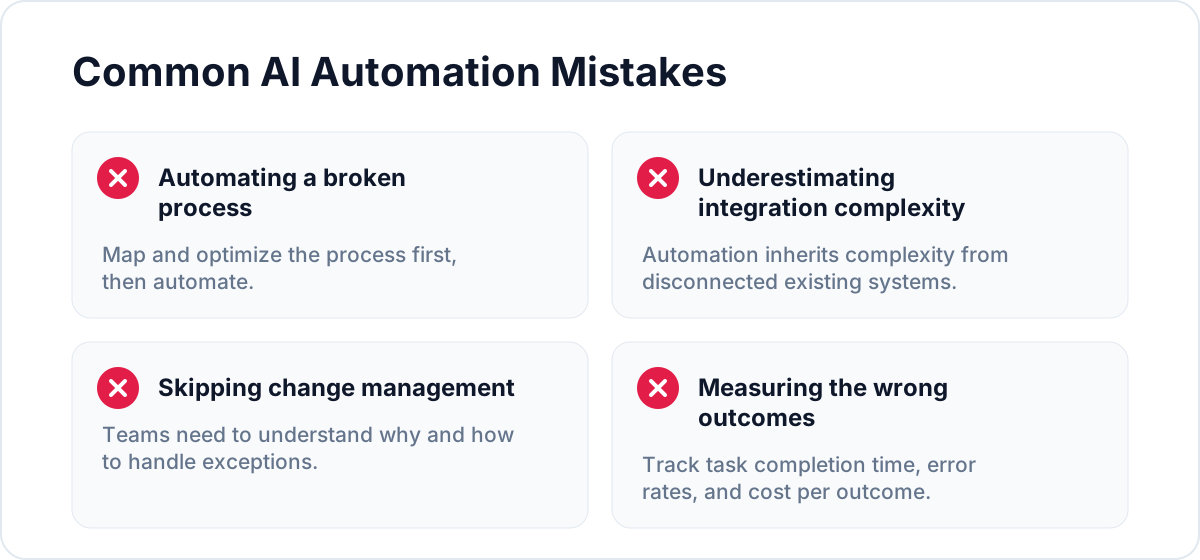
Automating a broken process. AI does not fix a bad workflow. It amplifies it. Map and optimize the process first, then automate.
Underestimating integration complexity. Most real-world automation value sits at the intersection of two or more existing systems. Your CRM, your support platform, your ERP, and your data warehouse were not built to talk to each other. The automation layer inherits that complexity.
Skipping change management. The teams whose workflows are being automated need to understand why, what changes for them, and how to handle exceptions. Automation that bypasses people tends to accumulate quiet technical debt as edge cases pile up unaddressed.
Measuring the wrong outcomes. Track task completion time, error rates, and cost per outcome. Do not measure lines of code automated or number of API calls as proxies for business value.
Building vs. Buying: When Custom Automation Pays Off
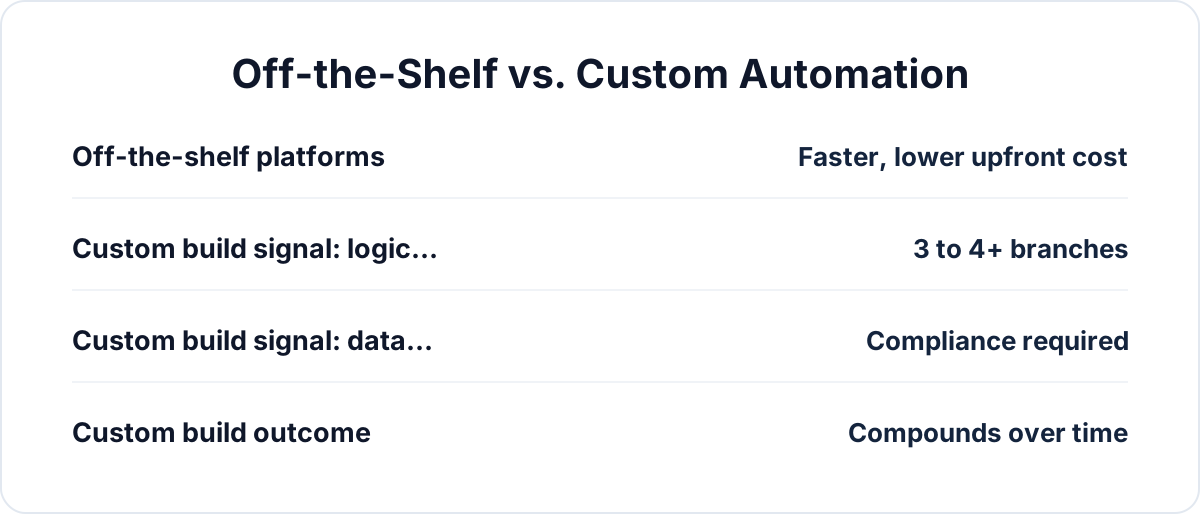
Off-the-shelf platforms are the right starting point for most teams. They are faster to deploy and carry lower upfront cost. But there are clear signals that you have outgrown them:
- Your automation logic requires more than three or four conditional branches with business-specific rules.
- You are processing volumes that exceed the platform's pricing model without predictable ROI.
- You need to integrate deeply with proprietary internal systems.
- Compliance or data residency requirements prevent you from sending data to a third-party cloud.
At that point, a custom-built automation layer, built on your own infrastructure using open-source LLM frameworks and cloud-native architecture, becomes the more sustainable investment. It costs more upfront but compounds in value as your workflows evolve. LetrionAI's [guide to AI engineering for beginners](/blog/getting-started-with-ai-engineering) is a good next read if you want to understand the technical foundations before scoping a custom build.
FAQ
What is the difference between AI automation and traditional automation?
Traditional automation executes fixed, rule-based logic: if X, do Y. AI automation can handle ambiguous inputs, make judgment calls based on context, and improve over time with feedback. The practical difference is that AI automation can process unstructured data like text, images, or audio, while traditional automation requires clean, structured inputs.
Which business functions benefit most from AI automation tools in 2026?
Customer support triage, contract and document review, internal knowledge retrieval, lead qualification, and code generation consistently show the strongest ROI. These are all high-volume, repetitive tasks where AI judgment is good enough to handle the majority of cases and where human review of edge cases is easy to implement.
Do I need a large engineering team to implement AI automation?
Not to start. A single technical product manager working with a no-code workflow platform can ship a useful automation in days. However, as complexity and data volume grow, you will need engineering support, particularly for reliable error handling, monitoring, and integration with core systems.
How do I measure the ROI of an AI automation project?
Define a baseline before you build: hours spent per week on the task, error rate, and cost per unit processed. After deployment, measure the same metrics. A good automation should show meaningful improvement within 60 to 90 days of production use. If it does not, diagnose whether the issue is in the model, the data quality, or the process design.
---
The right AI automation tools do not just save time. They create compounding capacity, letting your team focus on the decisions and creative work that actually move the business forward. Start with one high-volume, well-defined workflow, instrument it carefully, and expand from there. If you need a technical partner to design or build the automation layer, that is exactly the kind of work LetrionAI does for startups and enterprises across Europe and beyond.