
How to Choose AI Automation Agencies: Key Questions to Ask
 Vladimiros MykogianAugust 4, 2026
AI automation agencies are not all built the same, and picking the wrong one can cost you months of runway and real money. The right agency delivers measurable workflow improvements, integrates cleanly with your existing stack, and treats automation as a long-term engineering investment, not a one-time setup. Here is exactly how to evaluate them before you commit.
What AI Automation Agencies Actually Do (and What They Should Not)
A credible AI automation agency does three things well: it maps your business processes, identifies where AI creates genuine leverage, and then engineers reliable systems that run without constant hand-holding.
What they should NOT do: oversell generic no-code workflows as "custom AI," propose solutions before understanding your data, or disappear after the first deployment.
Be immediately skeptical of any agency that leads with tool names rather than outcomes. The technology stack matters, but the ability to translate your operational pain points into working automation matters far more.
The First Filter: Industry Experience vs. Technical Depth
There are two types of AI automation agencies in the market right now. The first has deep industry expertise in one vertical (logistics, fintech, healthcare) but limited engineering range. The second has broad technical depth, covering LLM integration, custom APIs, cloud infrastructure, and workflow orchestration, but needs a proper onboarding phase to understand your domain.
For most startups and scaling businesses, technical depth wins. Your industry knowledge already lives inside your team. What you are buying is engineering execution and AI architecture. An agency that can build and integrate across your full stack (frontend, backend, data pipelines, and AI layer) gives you far more flexibility as your needs evolve.
Ask directly: "Can you show me a project where you built a custom AI integration rather than connecting pre-built tools?"
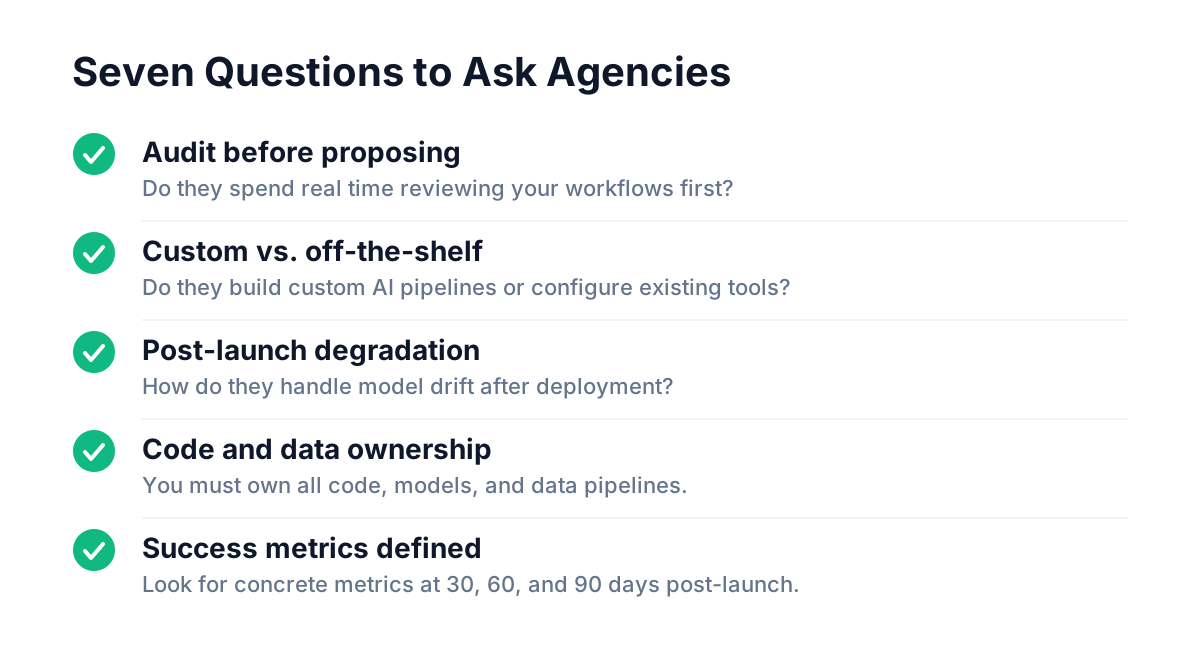
Seven Questions to Ask Every AI Automation Agency
These are the questions that separate serious technical partners from polished sales pitches:
- What does your discovery process look like before you propose a solution? A good agency spends real time auditing your workflows before recommending anything.
- Do you build custom AI pipelines, or do you primarily configure off-the-shelf automation platforms? Both have their place, but you need to know which you are getting.
- How do you handle model drift and performance degradation after deployment? AI systems degrade over time. If the agency has no answer, they are not thinking past launch.
- What does your QA and testing process look like for AI-generated outputs? Automation errors can compound fast. You need guardrails, not just confidence.
- Who owns the code, models, and data pipelines at the end of the engagement? The answer should always be: you do.
- Can you integrate with our existing stack? Name your actual tools and platforms and watch how specifically they respond.
- What does success look like at 30, 60, and 90 days post-launch? Vague answers here are a red flag. Look for concrete metrics tied to your business goals.
Red Flags That Should Make You Walk Away
Some warning signs are obvious, others are subtle. Watch for all of these:
- No technical portfolio, only case study PDFs. Real engineering work leaves a trail. Ask to see repositories, architecture diagrams, or live products.
- They pitch the same solution to every client. A legitimate agency proposes different architectures depending on your data volume, compliance requirements, and existing infrastructure.
- Aggressive lock-in clauses. Proprietary platforms you cannot migrate away from, or contracts that restrict your access to your own data, are dealbreakers.
- Junior-only teams on complex builds. Ask specifically who will be leading the technical architecture on your project.
- No post-launch support plan. AI automation is not a "set and forget" discipline. Maintenance, retraining, and monitoring are essential parts of the service.
How to Evaluate Their AI Engineering Capabilities Specifically
Not every digital agency that uses the word "AI" has genuine AI engineering depth. Here is a practical way to test it during the sales process:
Ask them to walk you through how they would approach a specific automation problem in your business. A strong agency will immediately ask clarifying questions about your data sources, volume, latency requirements, and integration constraints. A weak one will jump straight to tool recommendations.
Technically, look for fluency with LLM orchestration, retrieval-augmented generation (RAG) for enterprise knowledge bases, fine-tuning versus prompt engineering trade-offs, and cloud deployment on platforms like AWS or GCP. An agency that can discuss these trade-offs honestly, including when NOT to use AI, is one worth trusting.
For a deeper grounding in how modern AI systems are architected, the Machine Learning section of the AWS Well-Architected Framework is a useful reference when forming your own evaluation criteria.
A Practical Mini-Checklist for the Technical Review
- Can they explain their approach to prompt versioning and evaluation?
- Do they have experience with vector databases or semantic search?
- Can they build and deploy containerized AI services (Docker, Kubernetes)?
- Do they implement logging and observability for AI outputs in production?
If the answer to most of these is yes, you are talking to engineers, not resellers.
Pricing Models and What They Signal
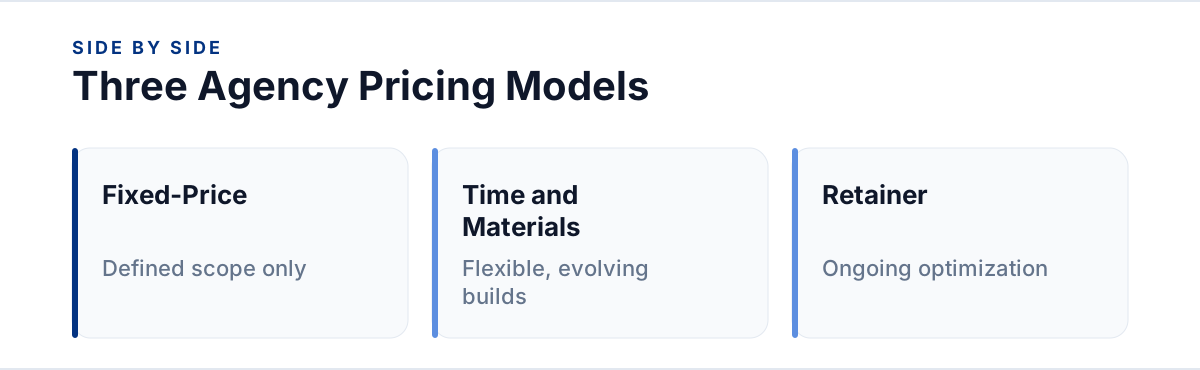
AI automation projects can be scoped in several ways, and the pricing model itself tells you something about how the agency operates.
Fixed-price projects work well for clearly scoped automations with defined inputs and outputs. They signal confidence in the agency's estimation ability.
Time-and-materials makes sense for exploratory or complex builds where requirements will evolve. It requires more trust but gives you flexibility.
Retainer-based models are ideal for ongoing AI optimization, retraining cycles, and continuous improvement, which is where most of the long-term value lives anyway.
Be cautious of agencies that only offer one model regardless of your project type. A genuinely client-focused partner will recommend the pricing structure that matches your actual situation.
What a Strong Engagement Looks Like in Practice
The best AI automation engagements follow a clear pattern: discovery, architecture proposal, phased delivery with checkpoints, and a structured handover with documentation.
A small SaaS team, for example, might start with a single automated pipeline that routes and classifies customer support tickets using an LLM, measures the reduction in manual triage time, and then expands the automation layer once the first phase proves its value. That iterative approach protects your budget and builds internal confidence in the technology.
The agency should also be transferring knowledge to your team throughout the process, not creating dependency. If you finish an engagement without understanding what was built and why, the agency has failed you.
FAQ
How much do AI automation agencies typically charge?
Project costs vary widely based on complexity and scope. Simple workflow automations may start in the low four figures, while custom LLM integrations with cloud infrastructure can range into the tens of thousands. Always ask for a breakdown by phase so you can evaluate value at each stage.
What is the difference between AI automation agencies and no-code automation consultants?
A no-code consultant configures existing platforms to connect your tools. An AI automation agency, at full capability, designs and builds custom AI systems, including model selection, data pipeline architecture, and deployment infrastructure. Both are valid depending on your needs, but they are not the same thing.
How long does a typical AI automation project take?
A focused automation project with a clear scope, for example automating a single business process end-to-end, can take four to eight weeks. More complex builds involving custom model integration and enterprise data infrastructure typically run three to six months.
What should I have ready before approaching an AI automation agency?
Come prepared with a clear description of the process you want to automate, your current toolset and data sources, any compliance requirements (especially important in regulated industries), and a realistic sense of budget range. You do not need a technical specification, but the more context you provide, the faster and more accurate the agency's proposal will be.
---
Choosing among AI automation agencies is ultimately a judgment call about trust, technical credibility, and strategic fit. Take your time during the evaluation, ask the hard questions above, and prioritize agencies that push back thoughtfully rather than agreeing with everything. The right partner will make your decision obvious before you ever sign anything.