How to Choose a Cloud Infrastructure Provider in 2026
 Vladimiros MykogianSeptember 21, 2026
Choosing a cloud infrastructure provider for a SaaS or mobile app means deciding who runs the servers, networking, storage, and core services your product depends on. The right choice gives you predictable costs, strong security, and room to grow without rewrites. The wrong one traps you in outages, surprise bills, and painful rewrites just when growth starts.
This guide walks you through how to choose, compare, and negotiate with providers so your app has a stable, scalable foundation from day one.
What does a cloud infrastructure provider actually do for your app?
A cloud infrastructure provider supplies the compute, storage, networking, and managed services that your SaaS or mobile backend runs on. Instead of buying and running your own servers, you rent what you need, when you need it.
For a typical SaaS or mobile backend, the provider is responsible for:
- Running virtual machines or containers where your APIs and services live.
- Offering managed databases and storage for your data and files.
- Providing networking, load balancers, and content delivery so traffic reaches your app quickly.
- Handling physical security, power, cooling, and often core compliance certifications.
The reason this choice matters is simple: almost every architectural decision you make will sit on top of your provider. Pricing models, deployment tooling, monitoring, even how you debug production issues will be influenced by that platform. Founders who treat this as a one-time procurement decision usually regret it. You want to view it as choosing a long-term technical partner and design your product architecture around that assumption.
Key criteria to evaluate when choosing a cloud infrastructure provider
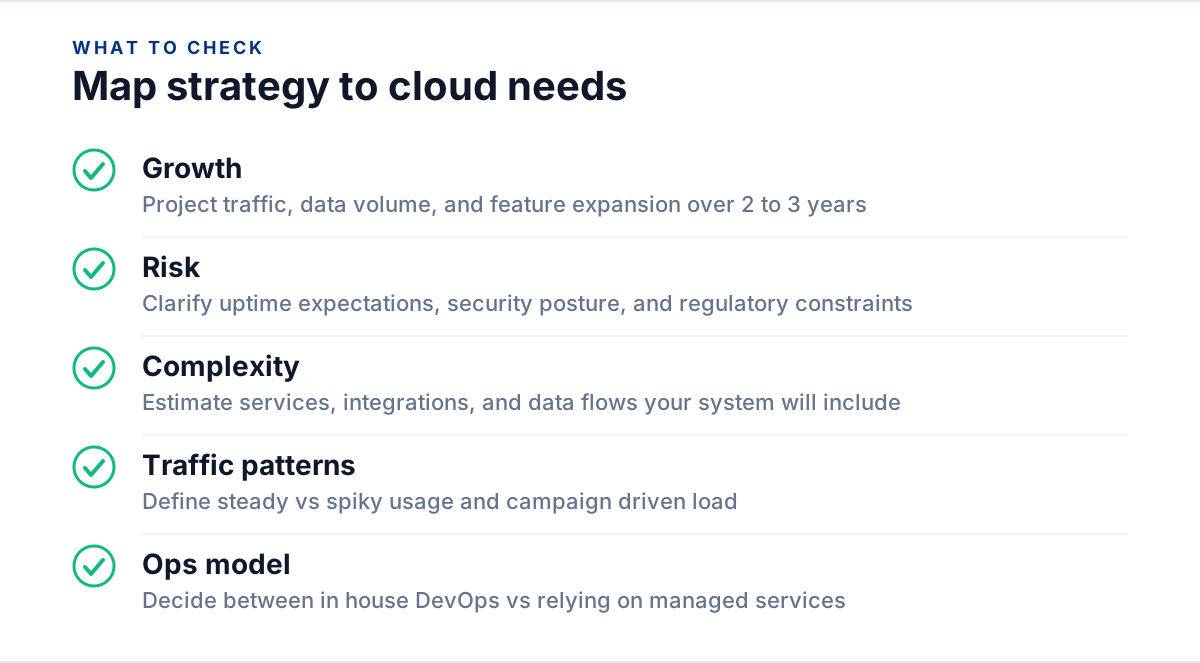
To choose a provider, focus on the few criteria that directly affect your product: cost model, reliability, performance, security, and developer experience. Everything else is noise for most teams.
Here are the main dimensions to assess:
- Cost and pricing model: Transparent pricing, clear discounts, predictable monthly bills, and easy cost visibility. Watch out for data transfer fees and hidden managed service costs.
- Reliability and SLAs: Documented uptime commitments, regional redundancy options, and clear incident communication channels.
- Performance: Regions close to your users, modern instance types, and CDN options for static content and APIs.
- Security and compliance: Strong identity and access management, encryption options, logging, and support for relevant standards in your industry.
- Developer experience: Good SDKs, CLI tools, Terraform support, and clear documentation so your team ships faster instead of fighting the platform.
- Managed services ecosystem: Databases, queues, caches, monitoring, and CI/CD integrations that match your stack and skillset.
As a rule of thumb, if a provider scores poorly on reliability or security, move on. You can work around mediocre tooling; you cannot fix outages and security gaps that come from the platform itself.
Comparing cloud providers for SaaS and mobile apps
Once you know your criteria, you need a structured way to compare options. The goal is not to pick the provider with the most features. The goal is to pick the one that matches your product stage, team skills, and growth plans.
Use a simple comparison matrix like the one below as a working document with your team.
| Criterion | Provider A | Provider B |
|---|---|---|
| Regions near target users | ||
| Uptime SLA | ||
| Pricing transparency | ||
| Data transfer costs | ||
| Managed database options | ||
| Kubernetes / container support | ||
| IAM and security features | ||
| Monitoring and logging tools | ||
| Support responsiveness | ||
| Ease of migration |
Populate this table using real project requirements. For a consumer mobile app with heavy media, you might prioritize global CDNs and object storage. For a B2B SaaS handling sensitive data, you may rate IAM, audit logs, and compliance support higher. The right comparison is specific to your app, not to generic benchmarks.
How your product stage should shape your decision
The "best" cloud infrastructure provider depends heavily on where your product is right now. Early prototypes need different trade offs than a scaling SaaS with paying customers.
Pre-MVP or prototype stage
At this stage, speed of iteration is more important than optimal pricing. You want a provider that your team can deploy to in hours, not weeks.
Focus on:
- Simple deployments and managed services over self-managed clusters.
- Built-in CI/CD or easy integration with your existing pipelines.
- A free tier or low entry cost so you can experiment.
Do not over optimize for multi-region redundancy or exotic networking. If you are still testing product market fit, optimize for developer velocity.
Post-MVP with first paying customers
Now reliability and basic observability matter. Outages hurt your brand, not just your ego.
You should:
- Move to separate staging and production environments.
- Introduce structured monitoring and alerting.
- Review your provider's uptime history and incident track record.
This is also the right moment to revisit your cost model and confirm there is a clear path to profitability as usage grows.
Scaling SaaS or mobile app
Once you are handling significant traffic or revenue, your cloud decisions are strategic. Migration mistakes can cost months.
For this stage, prioritize:
- Strong support for infrastructure as code, for example mature Terraform providers.
- Kubernetes or container services if your architecture is service oriented.
- Advanced networking: VPCs, peering, private links to key partners.
- Cost optimization tools and billing exports so you can control margin.
Teams here also benefit from stronger DevOps practices and CI/CD, which you can deepen using ideas similar to those in a dedicated CI/CD best practices guide.
How to choose a cloud infrastructure provider step by step
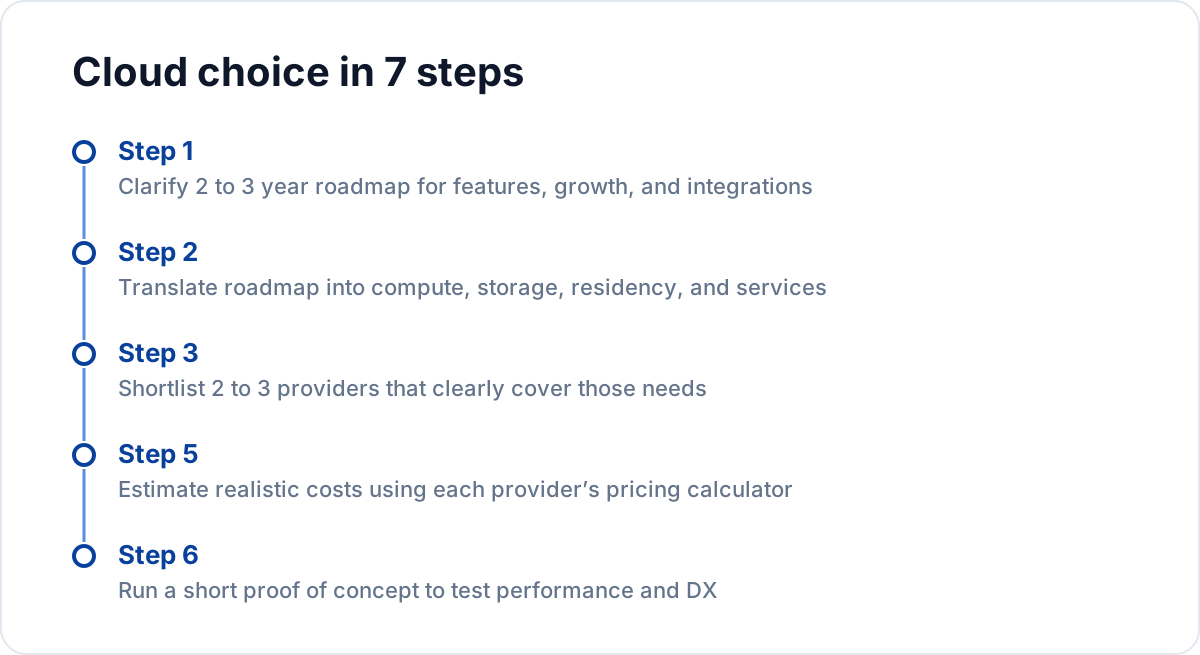
You can make this decision in a structured way that reduces risk and emotion. Use this 7 step process.
- Define your non negotiables: List must haves such as data location, uptime targets, compliance needs, or specific managed databases.
- Inventory your team skills: Capture what your developers already know, for example Kubernetes, specific databases, or infrastructure as code tools.
- Shortlist 2 to 3 providers: Based on non negotiables and skills, pick a small set to evaluate in depth.
- Design a reference architecture: Sketch your target architecture for each candidate provider, including compute, database, storage, and networking.
- Run a proof of concept: Deploy a small but realistic slice of your app on each provider, then measure performance, ease of deployment, and debugging experience.
- Estimate costs with real workloads: Use your POC metrics to estimate monthly costs at current and projected usage, focusing on compute, storage, and data transfer.
- Decide and document: Choose the provider, then document the trade offs, constraints, and migration plan so the whole team understands the decision.
Following a process like this avoids the loudest voice in the room winning by default. It also leaves a paper trail for future engineers who inherit your architecture.
How architecture and cloud provider choices interact
Cloud provider choice and system architecture influence each other. Treating them separately is a mistake that often leads to rework.
What is a cloud architecture?
A cloud architecture is the structured way your application uses cloud services, including how compute, storage, networking, and managed services fit together to meet your performance, availability, and security goals.
For a SaaS or mobile backend, your architecture covers:
- How your API, background workers, and admin tools are deployed.
- Which databases, caches, and queues you use and how they connect.
- How you secure traffic, handle authentication, and manage secrets.
- How you monitor, log, and roll out new versions.
Provider centric vs provider agnostic design
A provider centric architecture uses many proprietary managed services from one provider. This often speeds up development and simplifies operations but makes migration harder.
A provider agnostic architecture relies more on open standards and portable tooling, such as containers, Terraform, and widely supported databases. This can keep future options open but sometimes increases operational overhead.
The practical approach for most teams is a middle ground. Use managed services where they clearly save you time, especially for databases and observability, while keeping core business logic portable using containers and standard APIs.
If you want a deeper primer on how architecture choices affect user experience and conversion, pairing this with a UX focused guide such as UX and UI Design: What It Is and How to Get It Right is often helpful.
Common mistakes teams make when selecting a provider
Teams rarely regret choosing a stable, boring provider that matches their skills and growth. They do regret decisions driven by hype, discounts, or incomplete information.
Here are frequent mistakes to avoid:
- Chasing the biggest discount: Large credits or aggressive discounts can look attractive, but if the platform does not match your stack, you may pay for it later in slower development and migration costs.
- Ignoring data transfer pricing: Many teams model only compute and storage costs. Data transfer, especially egress, can be the silent bill that grows fastest.
- Underestimating operational overhead: Running your own databases or Kubernetes clusters without enough expertise leads to outages and stress.
- Locking into proprietary services too early: Some managed services are excellent, but adopting them before you validate long term fit can make later migration painful.
- Skipping a production like test: Testing only in trivial environments can hide reliability or performance issues that show up under real traffic.
A seasoned technical partner can help you avoid these traps by bringing patterns from previous projects instead of treating your app as a first experiment.
When to bring in external expertise for your cloud decision
You do not need a full time DevOps team to make a strong cloud decision, but you do need someone who has seen more than one architecture in production. The inflection points where outside help adds the most value are:
- You are planning a full rebuild of a legacy system.
- You are about to sign a multi year contract with a provider.
- You are introducing containers, Kubernetes, or service oriented architecture for the first time.
- You are merging systems after an acquisition.
At LetrionAI, for example, we have delivered more than 150 projects across web, mobile, backend engineering, design, and workflow automation on top of major cloud providers, often using Docker, Kubernetes, and Terraform. That breadth makes it easier to identify where a provider fits or fights your goals instead of learning those lessons for the first time inside your product.
If you do decide to work with an external studio or consultant, judge them on how clearly they can explain trade offs in your context, not on how many buzzwords they can list. A good partner will talk in terms of reliability, margin, and user experience rather than just instance types and clusters.
Conclusion: make your cloud choice a strategic asset
Your cloud infrastructure provider is not just a line item in your budget. It is part of your product strategy, your reliability story, and your margin structure.
Start by defining what your app really needs today and in the next 18 to 24 months. Compare a small set of providers against those needs, run a focused proof of concept, and make the decision deliberately. Avoid common traps like chasing discounts or overcomplicating architecture before product market fit.
If you want a second set of eyes on your plan, walk through your current architecture, or stress test a migration strategy, schedule a short consultation with a senior engineer. An hour spent clarifying this choice now can save months of rework once your app is in the hands of real users.