
Retrieval Augmented Generation: How It Makes AI More Accurate
 Vladimiros Mykogian6 Αυγούστου 2026
Retrieval augmented generation (RAG) is an AI architecture that makes large language models dramatically more accurate by connecting them to an external knowledge source at the moment they generate a response. Instead of relying solely on what was baked into training weights months or years ago, a RAG system pulls relevant, up-to-date context and hands it to the model before it writes a single word. The result: fewer hallucinations, fresher answers, and AI that actually knows your business.
If you are building a product, automating a workflow, or evaluating whether to integrate an LLM into your stack, understanding retrieval augmented generation is no longer optional. It is the practical standard for production-grade AI in 2026.
Why Standard LLMs Fall Short in Business Contexts
A base language model is trained on a static snapshot of text. Once training ends, its knowledge freezes. Ask it about your internal product documentation, your latest pricing, or a client uploaded yesterday, and it has no idea. It will either admit ignorance or, worse, confidently invent an answer.
For consumer chatbots this is a tolerable quirk. For business applications, it is a dealbreaker. Startups and enterprises need AI that can answer questions about their specific data: support tickets, knowledge bases, contracts, product catalogs, compliance documents. That is precisely the gap retrieval augmented generation closes.
How Retrieval Augmented Generation Works: Step by Step
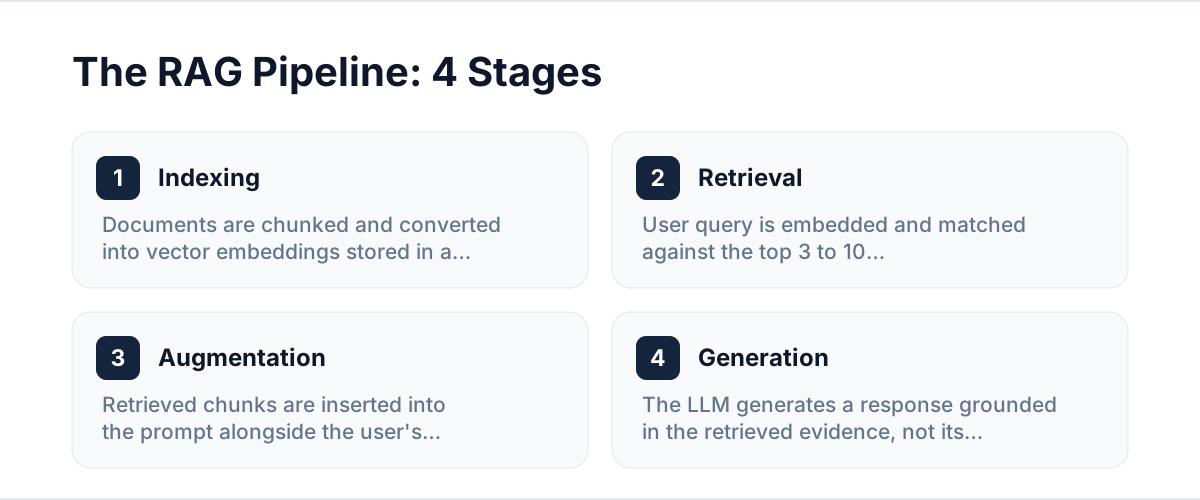
RAG is not magic. It is a well-defined pipeline with four clear stages:
- Indexing: Your source documents (PDFs, database records, markdown files, web pages) are split into chunks and converted into vector embeddings. These embeddings capture semantic meaning, not just keywords, and are stored in a vector database.
- Retrieval: When a user submits a query, the same embedding model converts the query into a vector. The system then searches the vector database for the chunks most semantically similar to the question, typically the top 3 to 10 results.
- Augmentation: Those retrieved chunks are inserted into a prompt alongside the user's original question. The model now has the relevant context in front of it, not locked away in weights.
- Generation: The LLM generates a response grounded in the retrieved evidence. Because the answer is anchored to real source material, it is far more likely to be accurate and attributable.
A small SaaS team might implement retrieval augmented generation to power an in-app assistant that answers user questions directly from their own help center, with every answer citing the exact article it drew from.
The Core Components You Need to Build a RAG System
Building RAG in production requires choosing the right pieces for each stage:
Embedding Models
The embedding model converts text into vectors. Quality here directly determines retrieval accuracy. Common choices include models from the OpenAI embeddings family or open-source alternatives hosted on Hugging Face. Match the model to your domain and language requirements.
Vector Databases
Purpose-built vector stores handle similarity search at scale. Popular options include Pinecone, Weaviate, Qdrant, and pgvector for teams already running PostgreSQL. Your choice depends on your infrastructure preferences and data volume.
The LLM
Any capable language model can serve as the generation layer: hosted APIs or self-hosted open-source models. The LLM's job here is constrained by design. It is supposed to synthesize and articulate the retrieved context, not invent.
Orchestration
Frameworks like LangChain and LlamaIndex exist specifically to wire these components together, handling chunking strategies, prompt construction, and retrieval logic. For teams who want tighter control, building a custom pipeline over raw APIs is also a realistic option.
RAG vs. Fine-Tuning: Which One Should You Choose?
This is the most common strategic question product teams face. The honest answer: for most business use cases, start with retrieval augmented generation.
Fine-tuning trains a model on your data, adjusting its weights. It is powerful for changing a model's style, domain fluency, or specialized reasoning, but it is expensive, slow to update, and does not solve the freshness problem. Every time your data changes, you need to retrain.
RAG, by contrast, is updateable in real time. Add a new document to your index and the model can reference it within minutes. It is also more auditable: you can show users exactly which source drove each answer, which matters enormously for compliance-sensitive industries.
The practical rule: use retrieval augmented generation when accuracy on your specific, changing data is the goal. Consider fine-tuning only when you need to reshape how the model reasons or writes, and then often combine both approaches.
Where RAG Delivers Real Business Value
The architecture shines in several concrete scenarios:
- Internal knowledge assistants: Employees query a model connected to company wikis, HR policies, and process documentation. Answer quality improves, and onboarding time drops.
- Customer support automation: A support bot references your product documentation and ticket history to resolve issues without hallucinating features that do not exist.
- Legal and compliance tools: Lawyers or compliance officers query contracts and regulation libraries. The retrieved chunks can be displayed as citations, making the output auditable.
- E-commerce product discovery: Shoppers describe what they need in natural language and the system retrieves semantically matching products from your catalog, not just keyword matches.
- Developer documentation assistants: Engineering teams query large, constantly evolving codebases or API references without reading thousands of lines manually.
In each case, the value is not the AI itself. It is the AI grounded in the right data, at the right moment.
Common RAG Pitfalls and How to Avoid Them
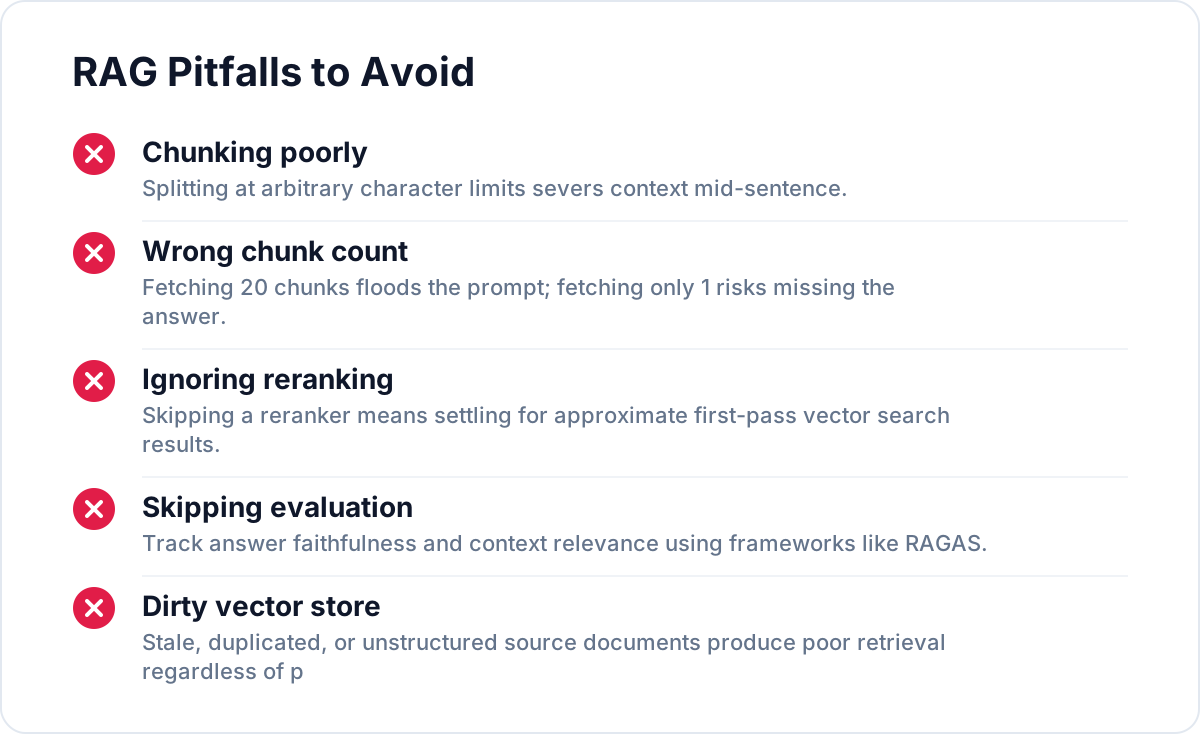
Even a well-architected retrieval augmented generation system can underperform if you make these mistakes:
- Chunking poorly: Splitting documents at arbitrary character limits can sever context mid-sentence. Use semantic chunking strategies that respect paragraph and section boundaries.
- Retrieving too many or too few chunks: Fetching 20 chunks floods the prompt with noise. Fetching only 1 risks missing the right answer. Test your retrieval recall and tune the top-k parameter with real queries.
- Ignoring reranking: A first-pass vector search is approximate. Adding a reranker model as a second pass, which scores retrieved chunks more precisely against the query, meaningfully improves answer quality.
- Skipping evaluation: RAG quality must be measured. Track metrics like answer faithfulness (did the model stay grounded?) and context relevance (did retrieval surface the right chunks?). Frameworks like RAGAS are built for this.
- Treating the vector store as a dump: Garbage in, garbage out. Stale, duplicated, or unstructured source documents will produce poor retrieval regardless of how sophisticated your pipeline is.
FAQ
What is the difference between retrieval augmented generation and a regular chatbot?
A regular chatbot generates responses from training data alone. A retrieval augmented generation system retrieves relevant documents from an external knowledge source first, then generates a response grounded in that content. This makes it far more accurate on domain-specific or time-sensitive questions.
Does RAG work with any language model?
Yes. RAG is a pipeline architecture, not a model-specific feature. It works with any LLM that accepts a prompt, whether that is a hosted API or a self-hosted open-source model. The quality of retrieval and the capability of the model both influence the final output.
How much data do you need to build a RAG system?
There is no minimum floor. Even a few dozen well-structured documents can produce a useful RAG assistant. The system scales naturally as you add more content to the index, with no retraining required.
Is retrieval augmented generation secure for enterprise use?
It can be. Because your documents are stored in your own vector database and the model only sees the chunks you retrieve, you have direct control over what data is exposed. For sensitive use cases, self-hosted embedding models and LLMs eliminate the need to send any data to a third-party API.
---
Retrieval augmented generation is currently the most practical path from "interesting AI demo" to "reliable AI feature" in a real product. The architecture is well-understood, the tooling is mature, and the business case is clear: AI that knows your data is AI that earns trust. If you are evaluating how to integrate LLMs into your product or workflow, starting with a RAG proof-of-concept on your own knowledge base is the highest-ROI first move you can make.