
How to Evaluate SaaS Development Companies: A Founder's Checklist
 Vladimiros Mykogian7 Αυγούστου 2026
The right SaaS development companies can cut your time-to-market in half and save you from a costly rebuild 18 months later. The wrong one will ship technically sound code that solves the wrong problem, or worse, disappear after the first milestone. This checklist gives startup founders and product leaders a structured, opinionated way to separate the genuinely capable saas development companies from the ones who simply look good on a discovery call.
Why Choosing a SaaS Development Partner Is Different in 2026
SaaS products today are not just web applications. They are distributed systems that need to handle multi-tenancy, subscription billing, role-based access control, AI-powered features, and continuous deployment, often from day one. A development company that built solid e-commerce sites a few years ago may not have the architecture fluency your product demands right now.
Before you open a single proposal, get clear on what you actually need: a partner who can own the full product lifecycle, or a delivery team that executes against your spec. Both are valid. Conflating them is where most founders lose money.
Step 1: Validate Their SaaS-Specific Technical Depth
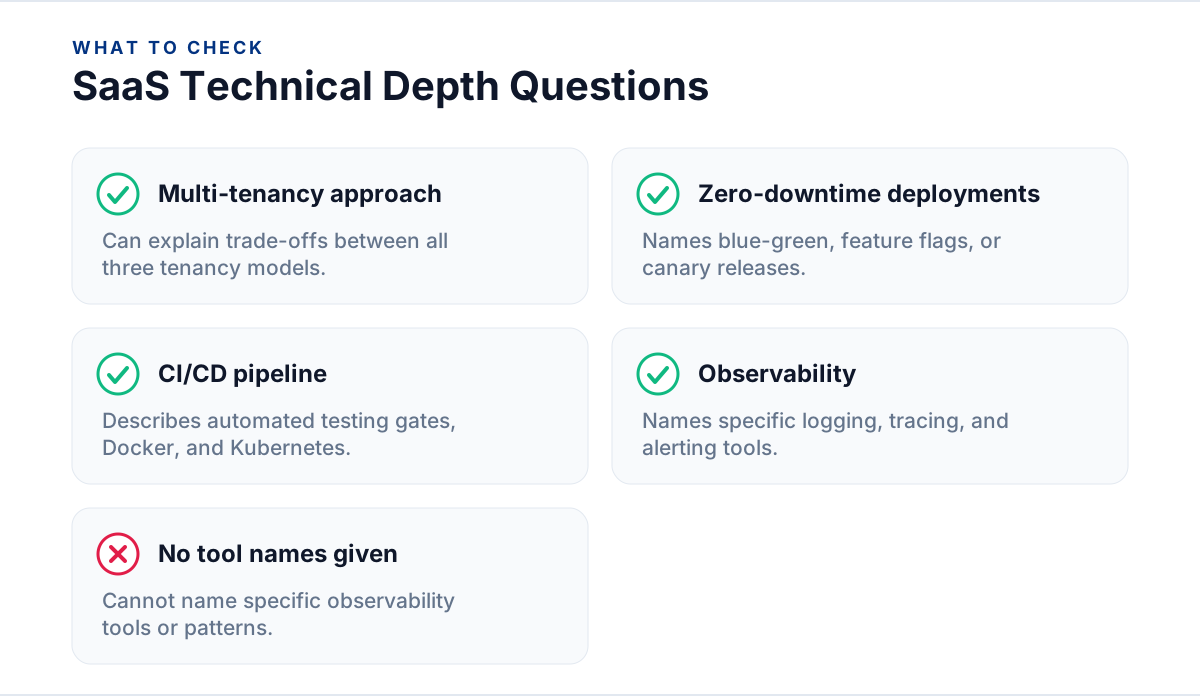
Generic software shops build things. SaaS-specialist teams build things that scale, recover gracefully, and cost predictably to operate. Ask every candidate these questions directly:
- What is your preferred approach to multi-tenancy? They should be able to articulate the trade-offs between database-per-tenant, schema-per-tenant, and shared-schema models without reading from a script.
- How do you handle zero-downtime deployments? Look for concrete answers: blue-green deployments, feature flags, canary releases.
- What does your CI/CD pipeline look like for a typical SaaS client? A mature team will describe automated testing gates, containerized builds (Docker), and orchestration on Kubernetes or a managed cloud equivalent on AWS or GCP.
- How do you approach observability? Logging, tracing, and alerting are not optional for SaaS. If they cannot name specific tools or patterns, that is a red flag.
You are not looking for a recitation of acronyms. You are listening for fluency: the ability to explain trade-offs and make a recommendation for your specific situation.
Step 2: Review the Portfolio of SaaS Development Companies With a Critical Eye
A polished case study is marketing. A real conversation about the case study is signal. When reviewing a SaaS development company's portfolio:
- Identify products that are live and generating revenue. Anyone can ship an MVP to a private beta. Ask which of their clients hit 1,000 paying users or beyond.
- Ask about architecture decisions that aged badly. A team confident in their craft will tell you honestly what they would do differently. A team that has only success stories is either hiding something or has not worked on complex enough products.
- Look for domain proximity, not just technology match. If you are building a B2B workflow tool, a team that has shipped two or three B2B SaaS products understands the nuances of onboarding, admin dashboards, and enterprise security requirements.
- Check the tech stack alignment. If your product roadmap calls for React on the frontend, Node.js on the backend, and AI automation via LLMs, a team whose portfolio is built on a completely different stack will have a real ramp-up cost that you will pay for.
Step 3: Pressure-Test Their Product Thinking
The best SaaS development companies do not just write code. They push back on weak assumptions before a single line is written. During evaluation, bring a real product challenge and watch how they respond.
A team with genuine product instincts will:
- Ask about your target user before asking about your feature list
- Question whether a requested feature solves the underlying problem
- Propose a phased delivery approach that gets something in front of users quickly
- Surface UX considerations early, because a technically perfect feature that confuses users is a failed feature
If their first response to your brief is a timeline and a cost estimate, treat that as a warning sign. If their first response is a set of clarifying questions, pay attention.
Step 4: Evaluate Their AI and Automation Capabilities
In 2026, a SaaS product that does not leverage AI in at least one meaningful workflow is leaving competitive advantage on the table. This does not mean bolting a chatbot onto your dashboard. It means thoughtful integration of LLMs and automation where they reduce friction for the end user or eliminate manual work for your team.
Ask candidate companies specifically:
- Have you integrated LLMs into a production SaaS product?
- How do you handle prompt versioning, cost management, and output validation in a live system?
- Can you show an example of AI-powered workflow automation you have built and the measurable outcome it delivered?
Companies that have done this work will have clear, specific answers. Those who have only experimented internally will hedge. For a deeper look at how modern AI integration fits into a SaaS architecture, the NIST AI Risk Management Framework is a useful reference for teams thinking about responsible production deployment.
Step 5: Examine Their Delivery and Communication Culture
Technical skill gets the product built. Culture determines whether the partnership survives the inevitable hard moments. Evaluate the following:
Transparency in Reporting
Do they provide structured progress updates, or do you have to chase them for status? A healthy engagement should include weekly written updates, access to a shared project board, and a defined escalation path when something goes wrong.
Ownership vs. Execution
Is the team proposing solutions proactively, or waiting to be told what to do? Ownership means flagging a risk before it becomes a problem. Execution means completing tasks. You need both, but you especially need ownership on a SaaS build where requirements evolve.
Client Retention Rate
Ask directly: what percentage of your clients extend their engagement beyond the initial project? A company confident in its delivery culture will answer without hesitation. A rate above 70 percent is a meaningful indicator. Above 90 percent is exceptional.
Step 6: Understand the Engagement Model and Handoff Plan
One of the most overlooked questions founders forget to ask: what happens when the project ends?
A responsible SaaS development company will:
- Deliver full source code ownership to you from day one, not after final payment
- Document the architecture, environment setup, and deployment process so your internal team or a future partner can take over
- Offer a clear maintenance and support model post-launch rather than disappearing after go-live
- Structure contracts so that the IP is yours, unconditionally
Be wary of any agency that makes handoff deliberately complex. Dependency is not a retention strategy worth accepting.
A Quick Pre-Shortlist Checklist
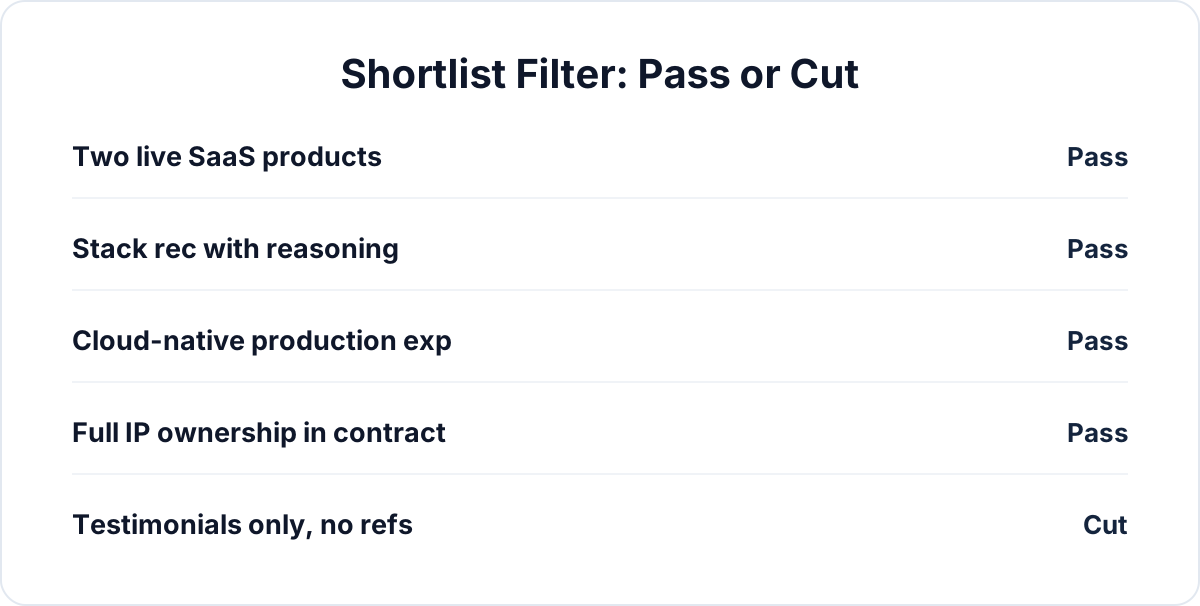
Before sending your first RFP, run through this fast filter:
- [ ] They have shipped at least two live SaaS products (not just MVPs)
- [ ] They can articulate a specific tech stack recommendation for your use case with reasoning
- [ ] They have production experience with cloud-native architecture (AWS or GCP, Docker, CI/CD)
- [ ] They ask about your users before your features
- [ ] They have at least one documented AI or automation integration in a real product
- [ ] Their contract gives you full IP ownership from the start
- [ ] They can provide direct references from SaaS founders, not just testimonial quotes
Any company that cannot clear this bar is not the right partner for a serious SaaS build.
FAQ
How do I know if a SaaS development company is too small for my project?
Team size matters less than process maturity. A six-person team with a clear technical lead, defined QA process, and senior architecture oversight can outperform a 50-person shop with poor coordination. Ask how they staff similar-sized projects and who is accountable for architectural decisions.
Should I choose a generalist agency or a SaaS specialist?
For a SaaS product, choose a specialist or a full-service agency that can demonstrate genuine SaaS depth. Generalists tend to optimize for delivery speed without accounting for the long-term operational costs of multi-tenancy, scalability, and subscription infrastructure.
How long does it take to build a SaaS MVP with a development partner?
A focused MVP with a clear scope typically takes 10 to 16 weeks with a competent team. Vague requirements, scope changes, and extended feedback cycles are the most common reasons projects run longer, not technical complexity.
What is a reasonable budget to evaluate?
The range varies significantly by scope. The more useful filter is value density: what do you get per euro or dollar spent? A cheaper team that requires three rounds of rework is never the cheaper option. Prioritize track record and communication culture over headline rate.
---
Choosing among SaaS development companies is ultimately a bet on people, process, and shared ambition. Use this checklist as a conversation guide, not a scorecard. The goal is not to find a team that checks every box on paper but to find one that earns your trust before you sign anything. If you want to talk through your specific build and whether your current thinking is headed in the right direction, start that conversation now. You will know quickly whether the fit is real.